
The Story Behind
CavBot
 5 min read

The ideas, decisions, and challenges that led me to build CavBot.
CavBot began with a 404 page.
I was building a small football game for a page that no longer existed. It was meant to make an otherwise forgettable part of a website feel more useful and less frustrating.
But while building it, I kept returning to a larger question:
Why do so many businesses learn that something is wrong with their website only after a customer tells them?
A broken page may seem small. But it can point to a bad link, an outdated campaign, a missing product, or a larger problem hiding elsewhere. The website owner may never know it happened. The visitor simply leaves.
That question became the starting point for CavBot.
The idea became much larger
At first, CavBot was focused on missing pages and helping visitors continue instead of reaching a dead end.
Then I started looking at everything else that can go wrong after a website launches.
Pages become slow. Forms stop sending. Links break. Search descriptions disappear. Errors begin affecting visitors. Accessibility problems go unnoticed. Traffic changes without a clear explanation.
The information exists, but it is usually spread across several tools. One product measures traffic. Another tracks errors. Another checks search performance. Another reviews accessibility.
That may be manageable for a large company with a dedicated team. It is much harder for a founder or small business owner who is already responsible for everything else.
CavBot grew from a better 404 experience into a platform for understanding what is happening across a website.
Building for what happens after launch
Most website tools focus on helping someone create or publish a site.
CavBot begins after that point.
A website is never truly finished. Pages change. New content is added. Old links remain online. Browsers update. Visitors behave in unexpected ways. A small change can create a problem somewhere else.
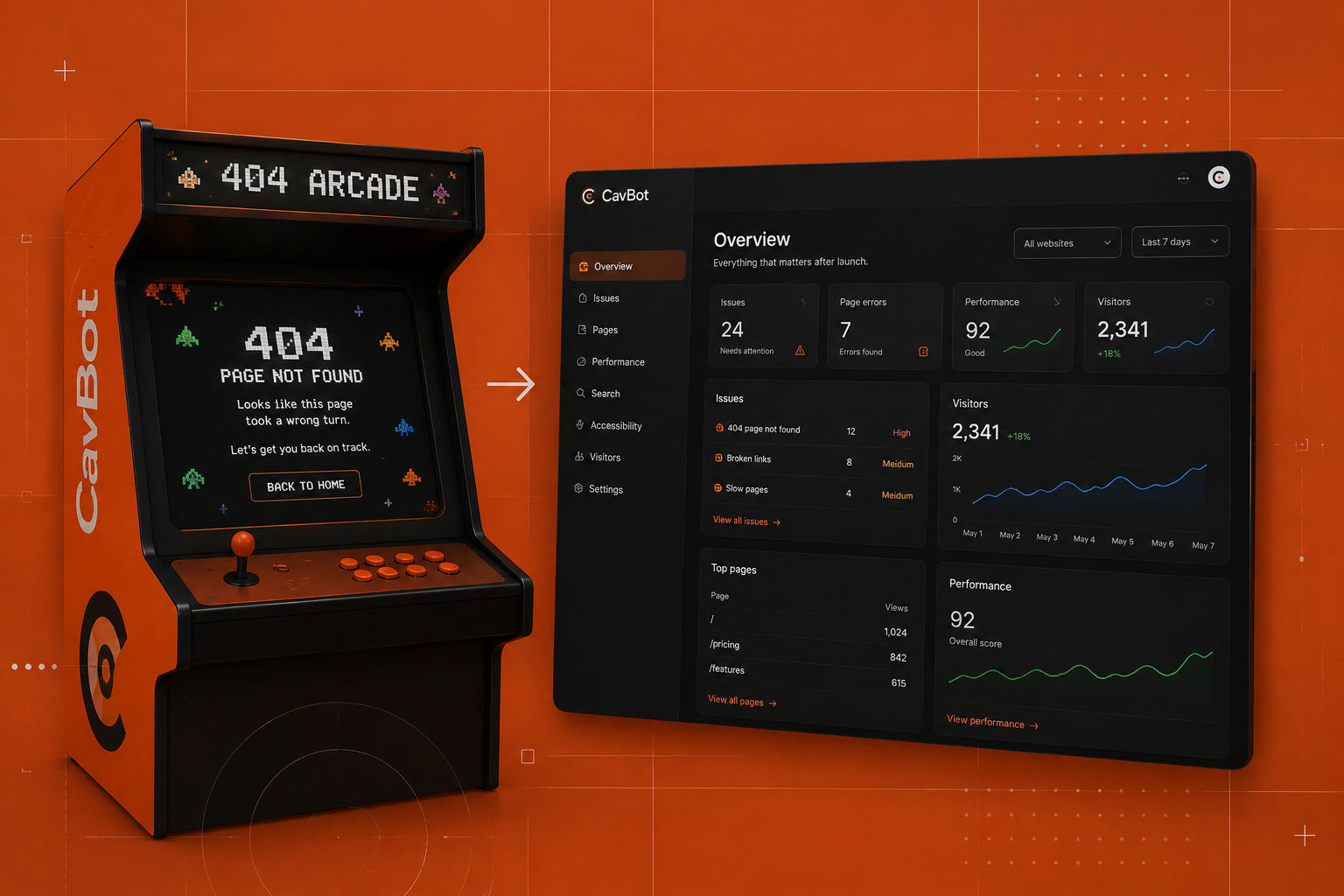
The goal of CavBot is simple: connect to a website, find problems, explain what happened, and help the owner respond.
That includes broken pages, website errors, search performance, accessibility, speed, and visitor activity. Instead of opening several reports and trying to connect the pieces alone, the owner can review them from one place.
I did not want CavBot to become another dashboard filled with numbers. Numbers are useful, but only when they help someone make a decision.
A business owner should not need to study a chart for twenty minutes to understand that a page stopped working.
The hardest part was deciding what CavBot should not become
Building more features is easy compared with deciding which features belong.
For a long time, I kept adding ideas because they seemed useful. The product became larger, but not always clearer.
I eventually had to step back and ask what CavBot was actually responsible for.
It was not meant to replace every tool a business already used. It was not meant to collect endless amounts of information. It was not meant to become a complicated system that required an engineer to understand.
CavBot needed to answer three basic questions:
- What happened?
- Why does it matter?
- What should happen next?
That became the standard I used when rebuilding the product.
If a feature could not help answer one of those questions, it needed to be simplified, moved, or removed.
Why the original 404 idea still matters
CavBot is much larger now, but the first 404 page still represents the reason I started building it.
A website should continue helping people even when something goes wrong.
That belief applies beyond missing pages.
When an error appears, the owner should understand it. When search traffic changes, there should be a clear place to investigate. When a visitor reaches an old link, the website should guide them somewhere useful. When a page becomes difficult to use, the problem should not remain hidden.
The 404 Arcade was the first version of that idea. It turned a dead end into something memorable while giving the visitor another way forward.
It was not the final product. It was proof that failure could be handled with more care.
Building CavBot alone
I have designed and built CavBot myself.
That has meant writing the code, shaping the product, creating the brand, rebuilding sections that did not hold up, and making decisions without a large team around me.
Some days have felt clear. Other days have involved questioning the entire company.
Building alone makes every weakness feel personal. When something fails, there is no department to blame. When the product becomes confusing, I have to admit that I made it confusing. When an idea does not belong, I have to let it go even after spending time building it.
But it has also given me a close understanding of every part of CavBot.
I know why each page exists. I know which decisions came from curiosity and which came from necessity. I know how far the product has moved from the first version.
The process has not been clean or predictable. Real building rarely is.
What CavBot is today
CavBot is a website intelligence platform.
It connects the parts of a website that are usually reviewed separately and gives the owner one place to understand its condition after launch.
The product is still growing. Some parts will change. Some ideas will be replaced by better ones. The language will become clearer. The product will become smaller in places and stronger in others.
But the purpose has remained the same since the beginning:
Websites have problems. CavBot helps people find them, understand them, and respond before they become larger problems.
That is the idea I started with.
I simply understand it much better now.
Cavendish Pierre-Louis
Founder of CavBot